
Should You Buy FLEX Tools?
By The Tool Bandit
FLEX is the brand that has confused American tool buyers more than any other in the last five years. A century-old German company, a 24V platform that reviewers rated alongside Milwaukee and Makita, and then a slow, messy exit from the only big-box store that carried it. This guide covers who actually makes FLEX tools, what they are best at, who uses them, where the brand goes from here, and what really happened at Lowe's.
The 30-second version
In a hurry? This is the whole article:
- Who makes them: FLEX-Elektrowerkzeuge, founded in 1922 in Germany, owned by China's Chervon since 2013. Chervon also owns EGO and SKIL, and makes Lowe's Kobalt tools.
- What they excel at: polishers and angle grinders, plus a 24V battery platform built on pouch-cell Stacked Lithium packs that hold power through the charge.
- Who uses them: detailers, body shops, stone fabricators, metal workers, and pros who want top-tier power without Milwaukee prices.
- The Lowe's story: exclusive US launch in 2021, shrinking shelf space from 2023, deep clearance through 2025, and dropped from Lowe's shelves in 2025 and 2026.
- Where it's headed: mostly online (Amazon) plus industrial distributors, with a new CEO hired to win back shelf space.
- Bottom line: the tools are good. The retail situation is the risk.
Who actually makes FLEX tools
FLEX started as Ackermann + Schmitt, founded in 1922 near Stuttgart, Germany, by Hermann Ackermann and Hermann Schmitt. The two inventors started the company to sell their creation: a grinder with a flexible shaft. That flexible shaft is where the FLEX name comes from, and the brand became so tied to the tool that "flex" entered the German dictionary as a word for angle grinders.
The company's place in tool history is real. By 1935 it was supplying its MS6 angle grinder, and in 1954 it built what it calls the first high-speed angle grinder. The company took the FLEX name in 1996. In 2013, it was sold to Chervon Holdings Ltd, a Chinese power tool company. FLEX still has its headquarters in Steinheim an der Murr, Germany, and it operates more independently than most of Chervon's other brands.
Chervon is the part most buyers miss. The same parent company owns EGO outdoor tools and SKIL, and it manufactures Lowe's Kobalt line. That leads to two common mix-ups, both worth clearing up. First, Chervon is not Chevron, the oil company. Second, sharing a parent does not make the brands interchangeable: FLEX 24V batteries do not fit Kobalt 24V tools. They are separate platforms that happen to come from the same company.
One more split to know: FLEX in North America is not quite the same lineup as FLEX everywhere else. Outside North America, FLEX sells red corded and cordless tools on 10.8V, 12V, and 18V systems. In the US and Canada, the focus is the black and gray 24V cordless platform, with the red look kept for corded tools. If you are shopping FLEX in the US, the 24V line is the system that matters.
What FLEX excels at
FLEX is not a generalist brand that happens to make everything. It is a specialist brand that built its name in a few categories and then expanded around them. Ranked by strength:
Polishers. This is FLEX's best category, and it is not close. Professional detailers knew the German brand long before American power tool buyers did, because FLEX makes some of the most respected polishers on the market. The 24V lineup covers all three polisher types: the FX3321 random orbital polisher (15mm throw, 11-speed dial, 4,350 RPM and 8,700 OPM), the FX3331 gear-driven orbital (the "CBEAST," which keeps cutting without pad stalling under pressure), and a 24V rotary polisher. Reviewers consistently praise the power consistency through the battery's run, the low vibration, and the ergonomics. The kits are not cheap (the FX3321 kit with two 5.0Ah batteries runs close to $700), but in detailing circles they are treated as a top-tier buy.
Angle grinders. The category the company invented, and still a strong one. The 24V 5-inch brushless grinder tops out at 10,000 RPM with four electronic speed settings, an anti-kickback sensor, and a slimmer handle than most small grinders. Testers found it held up under load as well as any other 5-inch cordless grinder they had used, with fast material removal and a polished finish on flap-disc work. The one consistent knock: no electronic brake.
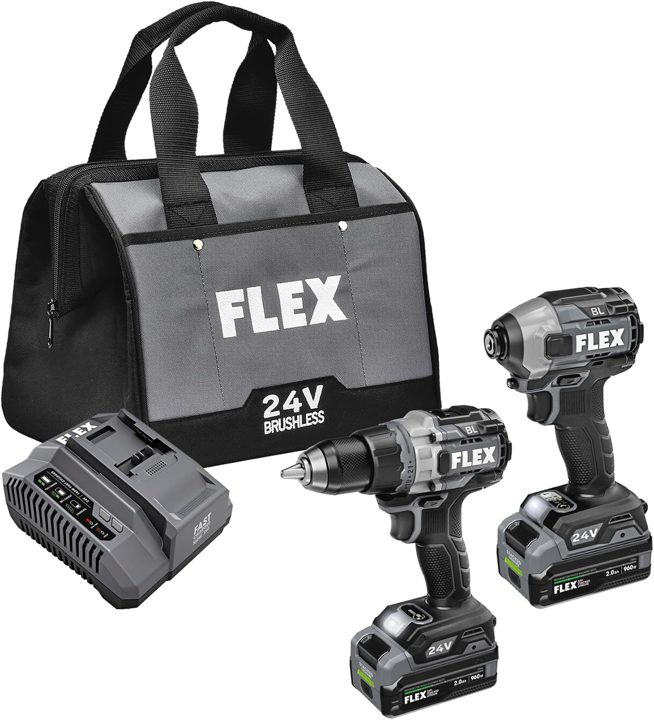
The 24V battery platform. FLEX's Stacked Lithium packs use pouch cells instead of the cylindrical cells in most tool batteries. The practical difference, noted by multiple reviewers, is that the tools hold their power through the discharge instead of fading as the battery drains, and the packs charge fast (a 160W fast charger comes in the kits). That battery tech is the reason the polishers and grinders perform the way they do.
Stone, concrete, and metal work. FLEX's European roots show here: wet polishers for stone fabrication (a category FLEX pioneered), drywall sanders, and surfacing tools. These are niche tools for tradespeople, not homeowner fare, and they are part of why the brand has a loyal pro following despite its small US footprint.
Should you buy Stacked Lithium batteries?
Stacked Lithium is FLEX's pouch-cell battery tech: instead of cylindrical cells, the packs use stacked pouch cells, and the practical difference reviewers note is that tools hold their power through the discharge instead of fading as the battery drains, plus fast charging. The buying rule is simple: every 24V kit ships with Stacked Lithium packs, so there is no separate battery choice to make. What you are paying for is that pouch-cell performance, and on polishers and grinders it is part of why the tools perform the way they do. If you are buying into the platform for drills and drivers, the battery does not close the lineup gap with Milwaukee or DEWALT. See also the battery math in the brand guide.
Is FLEX 24V real power or marketing?
FLEX 24V is 24 volts nominal, not a 20V MAX style label where the nominal working voltage is 18V. On paper, 24 volts against a 20V MAX label is roughly 20% more voltage, but voltage alone does not make a tool better: motor design, electronics, and ergonomics decide the real result. FLEX's polishers and grinders earn their reputation in tests, not on the label, so judge the tool, not the number.
Who uses FLEX tools
The core FLEX buyer is a working pro in one of the categories above: a detailer or body shop running polishers all day, a stone fabricator on wet polishers, a metal worker living on grinders. Beyond that, the brand picked up a second audience in the US: pros and serious DIYers who wanted Milwaukee or Makita XGT class power at a lower price. One longtime owner put it plainly, calling FLEX the only tools he would put in the same power and quality class as his Makita XGT gear.
The tradeoffs are worth stating plainly. The first-generation 24V tools are heavier and bulkier than rivals, and some owners describe them as a little unbalanced. FLEX has since added a compact 24V line, so buyers who want smaller, lighter tools have an option beyond the first-generation bulk. A few users report a slightly sloppy trigger with a small delay. And the lineup is narrower than Milwaukee or DEWALT: if you want one battery platform that covers everything from a miter saw to a lawn mower, FLEX is not that platform.
Who should skip it: anyone who wants to walk into a store for hands-on support, anyone building their first and only tool platform, and anyone uneasy about buying into a brand whose retail future is uncertain. The tools are the easy part of the FLEX story. The store shelf is the hard part.
The Lowe's controversy
FLEX's American story is really a Lowe's story, and it unfolded in four stages.
Stage 1: the big launch (2021). FLEX came to the US as a Lowe's exclusive, announced in spring 2021 with a launch event called the "FLEX Face Off" that put the new 24V tools head to head against top brands. Lowe's pitched it as a new cordless innovation for pros, and the early reviews were strong: high power, fast charging, and a lifetime warranty offer on launch-era kits for buyers who registered.
Stage 2: the slow fade (2023). Around mid-2023, owners noticed FLEX marketing going quiet and Lowe's aisles giving the brand less and less space. In late 2023 and early 2024, Lowe's cleared out the first-generation 24V tools. Those tools were not defective. Their bulkier design and premium launch pricing had limited their audience, and Lowe's moved the old SKUs out.
Stage 3: the fire sales (2025). Through 2025, FLEX went through round after round of deep clearance at Lowe's: discounts up to 50 percent, then up to 70 percent, plus short buy-one-get-one sales that let buyers walk out with armfuls of tools for a fraction of list price. Display models went up for sale. Store sections were reset, with FLEX space going to a larger DEWALT section. Forum reports said store managers were telling shoppers to "get what you can while you can" because the tools were "going away."
Stage 4: the exit (2025-2026). Reports conflicted for months: some stores kept stock, some went online-only, and Lowe's employees in forums pointed to a company-wide SKU consolidation rather than a FLEX-specific decision. By 2025 and 2026, the outcome was clear: FLEX and SKIL were both dropped from Lowe's shelves, and FLEX lost most of its US retail footprint. Lowe's never issued a big public farewell, which is why the exit felt so messy to the people watching it happen.
That mess is the controversy, and it split FLEX owners into two camps. Early adopters who paid full price watched their platform's only store disappear and wondered whether their batteries would be supported. Clearance buyers who loaded up at 70 percent off thought they had pulled off the deal of the decade. Both reactions make sense. The important distinction: Lowe's dropped the brand, but FLEX the company did not fold. The 24V platform continued, new tools kept coming, and the question became where the brand would sell next.
Where the brand is headed
FLEX's future in the US now runs through two channels. The first is online: FLEX now sells mostly through Amazon in the US, which is where most buyers will find the 24V lineup. The second is industrial distribution: in October 2026, Meyer Distributing, a wholesale distributor serving automotive and industrial markets, added FLEX to its catalog, starting with drills, impact drivers and wrenches, surfacing and polishing tools, and storage, all on the 24V platform, with more automotive-focused launches planned.
The product pipeline has not stopped either. FLEX is still tying new releases to the 24V platform, including a mini grinder and a cut-off saw, plus an organization ecosystem: TRACK-LOCK wall-mount storage and STACK PACK modular storage, showcased at trade shows in 2026.
The biggest signal about where FLEX is headed came in September 2026, when Chervon named Joseph Galli as its CEO. Galli ran TTI for sixteen years, overseeing Milwaukee's rise from contractor favorite to the pro market's biggest cordless platform and building Ryobi into the dominant DIY brand at Home Depot. Chervon's engineering was rarely the problem: on paper, FLEX tools measure up. The gap was distribution and brand pull, and Galli was hired specifically to close it.
Whether that works is an open question. The tool market is far more mature than it was when Galli built Milwaukee and Ryobi, and battery platform lock-in makes winning over new buyers harder than it used to be. But the hire tells you how Chervon sees the problem: FLEX has a marketing and distribution problem, not a quality problem. The brand's next chapter depends on whether Galli can win back shelf space or build an online and distributor business big enough to replace Lowe's.
What is FLEX's warranty now?
In the US, FLEX 24V tools, batteries, and chargers carry a 3-year limited warranty, extended to 5 years when you register within 30 days of purchase. Terms have varied by era: launch-era kits carried a lifetime warranty offer for buyers who registered, and the Limited Lifetime wording still seen in some places applies to Australia and New Zealand, not the US. Check FLEX's current US warranty page before you buy, and register within 30 days to get the extension.
Should you buy FLEX now?
It depends on what you are buying and what you already own. FLEX makes the most sense if you want a top-tier polisher or grinder and you are buying the tool, not the platform: the polishers in particular are among the best in their category at any price. It also made sense at clearance prices, where the value was overwhelming even with the retail uncertainty.
It makes less sense as your first and only battery platform. Milwaukee and DEWALT offer wider lineups, in-store support, and no questions about where the next tool comes from. And if you already own FLEX 24V tools, the read is reassuring but not certain: the platform is still supported, new tools are still coming, and Chervon is a huge company with every reason to keep it alive. What is gone is the convenience of walking into Lowe's for a battery on a Saturday morning.
The short version: buy FLEX for what it is best at, buy it online, and do not buy it expecting Lowe's to come back.
Where to buy FLEX tools now
Mostly online in the US, chiefly Amazon, plus industrial distributors such as Meyer Distributing and specialty dealers. Lowe's no longer carries FLEX in stores. See FLEX deals for current prices on this site.
FAQ
Who owns FLEX tools?
Chervon Holdings Ltd, a Chinese power tool company, has owned FLEX since 2013. FLEX itself is German, founded in 1922 as Ackermann + Schmitt near Stuttgart. Chervon also owns EGO and SKIL, and makes Lowe's Kobalt tools.
Is FLEX going out of business?
No. FLEX lost its Lowe's shelf space in 2025 and 2026, but the company is still releasing new 24V tools and Chervon hired a new CEO in September 2026. The risk for owners is retail availability, not the company folding.
Are FLEX tools good?
Yes, especially polishers and angle grinders. Reviewers rate FLEX polishers among the best available, and owners put FLEX 24V power in the same class as Makita XGT. The downsides are heavier first-generation tools and a smaller lineup than Milwaukee or DEWALT.
Are FLEX and Kobalt the same tools?
No. Both come from Chervon, which makes Kobalt for Lowe's, but they are separate brands on separate battery platforms. FLEX 24V batteries do not fit Kobalt 24V tools.
Where can you buy FLEX tools now?
Mostly online in the US, chiefly Amazon, plus industrial distributors such as Meyer Distributing and specialty dealers. Lowe's no longer carries FLEX in stores.
What is FLEX best at?
Polishers first: random orbital, gear-driven, and rotary polishers for detailing and body shops. Angle grinders second, which is the category the company invented in. Stone and concrete surfacing tools round out its strongest categories.
What are FLEX Stacked Lithium batteries?
Stacked Lithium is FLEX's pouch-cell battery tech: stacked pouch cells instead of the cylindrical cells in most tool batteries. Reviewers note the practical difference is that tools hold their power through the discharge instead of fading as the battery drains, plus fast charging. Every 24V kit ships with Stacked Lithium packs, so there is no separate battery choice to make.
Is FLEX 24V more powerful than DEWALT 20V MAX?
Not automatically. FLEX 24V is 24 volts nominal, while DEWALT's 20V MAX label covers an 18V nominal working voltage, so on paper 24 volts against a 20V MAX label is roughly 20% more voltage. But voltage alone does not make a tool better: motor design, electronics, and ergonomics decide the real result. Judge the tool in tests, not the number on the box.
What is FLEX's warranty?
In the US, FLEX 24V tools, batteries, and chargers carry a 3-year limited warranty, extended to 5 years when you register within 30 days of purchase. Terms have varied by era: launch-era kits carried a lifetime warranty offer for buyers who registered, and the Limited Lifetime wording still seen in some places applies to Australia and New Zealand, not the US. Check FLEX's current US warranty page before you buy, and register within 30 days to get the extension.
Sources
Brand history and ownership: Wikipedia: Flex-Elektrowerkzeuge, SlashGear: Who Really Owns All of the Major Tool Brands, SlashGear: Who Makes Flex Power Tools, and Are They Any Good?, Lincoln International: Flex Group sold to Chervon Group. Tool performance: Pro Tool Reviews: Flex 24V Cordless Polishers, Pro Tool Reviews: Flex 24V 5-Inch Angle Grinder, Dr. Beasley's: Flex FX3331 Review. The Lowe's exit: Garage Journal: Flex Power Tools thread. Where the brand goes next: Power Tools Insider: Chervon Taps Ex-TTI Chief to Lead FLEX and Skil, The Shop: Meyer Distributing Announces Partnership With FLEX, CCR Magazine: FLEX Showcases Tools, TRACK-LOCK at JLC LIVE 2026.
Deals live right now
Discounts verified November 11, 2026. The retailer price is the final authority.
Also in this series: DEWALT Tool Lines Explained, Milwaukee Tool Lines Explained, Which Power Tool Brand Should You Actually Buy?, Tool Brands Explained, Who Makes Ryobi?, Fake Milwaukee Tools on Temu.